
URSI™ - Universal Responsive Serial Interface
The world’s lowest 3.5x oversampling asynchronous serial communication scheme. Without PLL it offers ±20% jitter tolerance, immediate responsiveness, and ultra low standby power.
Industrial - Upgrade RS-485 into an IP-capable network with legacy support
Seamlessly support existing ModBus equipment on the same port while migrating to a modern IP capable network.
Bridge legacy Modbus and future URSI™/IP networks on the same twisted pair. Standard RS-485 is limited to 10 Mbps over short distances and lacks native IP support. URSI™ delivers 10 Mbps over 100 metres with low overhead framing for efficient IP packet transport, while its ±20% clock/jitter tolerance ensures reliable operation.
MeshDAQᵀᴹ Measurement and Automation for Industry & Residential: A distributed data acquisition and control system where URSI™ provides power, reliable communication, and a scalable mesh fail-safe architecture across a single twisted pair
Quartz-less sensors: Reliable interfacing with RC oscillator-based sensors under wide temperature stress
Building automation: Low-cost sensors and control over extended distances.
Neuromorphic & Event-Driven - Low-power responsive AER link
Address-event representation (AER) links spend most of their time idle. PLL-based links burn constant power. URSI™ consumes near-zero power in standby, wakes on the first edge, and resynchronises instantly, making it ideal for neuromorphic chips, event-based sensors, and spiking neural networks (SNN).
Requires single line or differential pair to connect neuromorphic devices.
Can carry power supply over a single differential pair.
Low latency, high reliability, low power consumption.
Embedded - Fast, low-cost chip-to-chip communication without SERDES
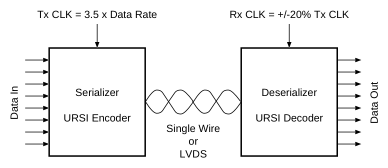
SPI and I²C are distance- and speed-limited. High-speed SERDES requires PLLs and complex PHYs. URSI™ offers a PLL-free, all-digital alternative with a tiny footprint.
FPGA to FPGA, FPGA to MCU, general low power and low cost inter-connectivity.
Easily clocked at 400 MHz in a typical FPGA, delivering 100 Mbps links. With double data rate (DDR) on LVDS I/O it achieves 200 Mbps.
A single isolation barrier can carry both data and clock, simplifying isolated interfaces (e.g., medical, industrial control).
Ideal as a low-latency debugging trace interface.
Comparison Table
Modulation |
Max Speed |
Signal Bandwidth |
Clock/Data Recovery |
Clock Tolerance |
Idle to 1st Bit |
Complexity / Cost |
|---|---|---|---|---|---|---|
URSI™ |
Gbps |
>0.6 x rate |
>3.5x Oversample |
Typical ±20% |
<3 bits |
Low |
USB Full-speed |
Mbps |
0.6 x rate |
4x Oversample |
±0.2% + Preamble |
<10 bits |
Medium |
Manchester |
Gbps |
1.0 x rate |
5x Oversample, PLL |
Preamble Sync |
2..64 bits |
Low / Medium |
NRZI UART |
Mbps |
0.6 x rate |
8..16x Oversample |
±2% |
<3 bits |
Low |
NRZI + 8b10, … |
Gbps |
0.6 x rate |
PLL CDR |
Preamble Sync |
<80 bits |
Higher |